


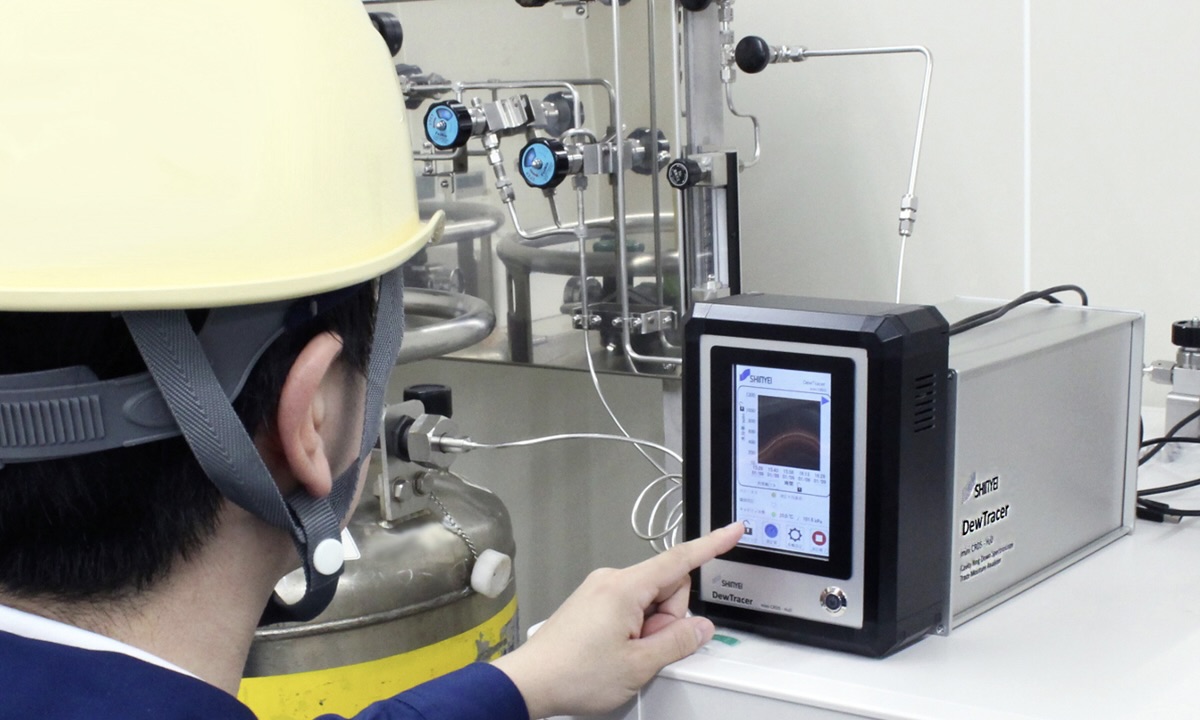
Kobe Keizai News— Trading house Shinyei Co. (3004) said its subsidiary Shinyei Technology Co. has had its CRDS trace moisture meter adopted by the Japan Aerospace Exploration Agency (JAXA) at the Tanegashima Space Center. The device will be used to control moisture levels when liquid fuel is filled into fuel tanks at extremely low temperatures.
Even minute amounts of moisture during fueling can freeze and clog piping or cause fuel defects, hindering the stable combustion of rocket engines. Until now, however, there had been no compact instrument capable of measuring extremely small amounts of moisture with high sensitivity and in a short time, while also being easily portable to measurement sites.
The product, named “DewTracer mini CRDS-H2O” (photo provided by Shinyei Technology), measures gas sampled from a designated point through a box-shaped sensor unit. It calculates moisture concentration using the cavity ring-down spectroscopy (CRDS) method, in which laser light is repeatedly reflected inside a sealed chamber equipped with highly reflective mirrors, and the time it takes for the light intensity to decay to a certain level is measured. Shinyei said it was the first in Japan to successfully develop and commercialize this CRDS-based trace moisture meter.
The device offers a detection sensitivity ranging from 12 parts per billion by volume (ppbv) to 20 parts per million by volume (ppmv). It can detect 15 liters of water vapor in a volume of gas equivalent to that of the Tokyo Dome. Fifteen liters of water vapor corresponds to the vapor produced when approximately 8.8 milliliters of water—just under two teaspoons—evaporates.
The product was launched in 2023 and is currently used mainly at semiconductor factories and other facilities. The underlying technology for detecting extremely small amounts of moisture was originally developed with support from JAXA’s Space Exploration Innovation Hub in joint research with the National Institute of Advanced Industrial Science and Technology (AIST). The initial aim was to develop technology capable of detecting even trace amounts of moisture on the Moon or Mars, with potential civilian applications in mind.
Although the product was completed, opportunities for Japanese teams to bring measurement instruments to the Moon or Mars have yet to materialize, while its applications on Earth have expanded. In this case, JAXA adopted the CRDS trace moisture meter in a form different from what had originally been envisioned.
コメントを残す